Some people arrive at Reiki after months of stress, poor sleep, or that hard-to-name feeling of being emotionally off balance. Others come because they want quiet, rest, and a gentler way to support their wellbeing. If you have been wondering what is Reiki and energy healing, the simplest answer is this: it is a complementary therapy that aims to support the body and mind by encouraging deep relaxation, energetic balance, and a greater sense of inner calm.
Reiki is not about force, pressure, or diagnosis. It is a hands-on or hands-near practice that works with the idea that energy flows through and around us. When that flow feels disrupted, people may experience stress, fatigue, emotional heaviness, or a sense of disconnection. Reiki practitioners work gently to help restore balance, creating space for the nervous system to settle and for the person receiving treatment to feel supported as a whole.
What is Reiki and energy healing in simple terms?
Reiki is a Japanese energy healing practice that is usually carried out with the client fully clothed, lying comfortably on a treatment couch. The practitioner places their hands lightly on or just above different areas of the body in a calm, structured sequence. The intention is not to manipulate muscles or joints, but to channel healing energy in a way that supports harmony in mind, body, and spirit.
Energy healing is the wider term. It includes Reiki, spiritual healing, and other practices based on the belief that wellbeing is influenced not only by physical factors, but also by our emotional and energetic state. Not every tradition explains energy in the same way, and not every client connects with the spiritual language around it. That is perfectly fine. Many people simply experience Reiki as a deeply restful treatment that helps them feel lighter, steadier, and more grounded.
This is where nuance matters. Reiki is best understood as a complementary therapy, not a replacement for medical care. It may sit beautifully alongside physiotherapy, counselling, massage, meditation, or conventional treatment plans. For many clients, the value lies in how it helps them pause, regulate, and reconnect with themselves.
How does Reiki work?
There is no single explanation that satisfies everyone, and a trustworthy practitioner should be honest about that. Traditional Reiki teaching describes the practitioner as a channel for universal life force energy, offering that energy where it is needed most. From a more modern wellbeing perspective, Reiki may support healing by helping the body shift into a calmer state, where rest and recovery become more possible.
When we are under prolonged stress, the body can stay stuck in high alert. Breathing becomes shallow, the mind stays busy, and true rest is hard to reach. A Reiki session often feels slow, quiet, and safe. That environment alone can help the nervous system soften. Some clients describe warmth, tingling, emotional release, or a floating sensation. Others feel very little during the session but notice afterwards that they are sleeping better, feeling clearer, or coping more calmly.
It depends on the person. Some people are highly sensitive to energetic work from the first session. Others need time to settle into it. Neither response is better than the other.
What happens during a Reiki session?
For first-time clients, uncertainty is often the biggest barrier. The reality is usually much gentler than people expect. A Reiki session begins with a short conversation about how you have been feeling and what you hope to receive from the treatment. This might include stress, emotional overwhelm, exhaustion, grief, anxiety, or simply the need for rest.
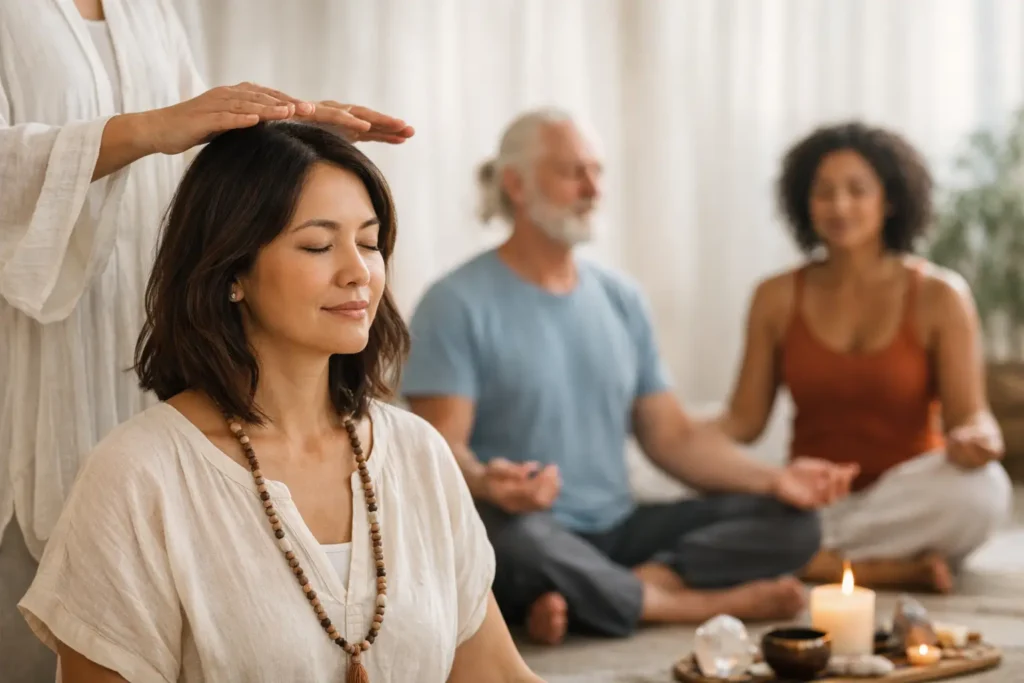
You remain fully clothed and are made comfortable on the couch, often with blankets or cushions to help you relax. The practitioner will then move through a series of hand positions around the head, torso, arms, legs, and feet, either with light touch or hands held slightly above the body. There is no need to do anything, perform anything, or even understand anything in a technical sense. Your role is simply to rest.
Sessions are usually peaceful and quiet, though some practitioners may use soft music or allow time afterwards to talk through what you noticed. It is common to feel deeply relaxed, emotionally tender, or unusually still. Occasionally, people become aware of feelings they have been holding in. In the right therapeutic setting, that can feel relieving rather than overwhelming.
What can Reiki and energy healing help with?
Reiki is often chosen by people who feel mentally overloaded, emotionally drained, or physically depleted. It is widely used to support stress reduction and relaxation, but its benefits can reach further than that. Clients often seek it during periods of change, burnout, grief, hormonal shifts, recovery, or spiritual growth.
Some people find Reiki helpful when they are struggling to switch off. Others come because they feel emotionally blocked or disconnected from themselves. It can also appeal to those who are already receiving body-based treatments and want support that feels quieter and more inward. In a holistic setting, Reiki may complement massage, reflexology, meditation, or emotional wellbeing support, depending on what a person needs at that stage of their journey.
That said, Reiki is not a guaranteed fix, and it should not be presented as one. It is subtle work. For some, one session brings a noticeable shift. For others, the benefit comes through regular treatment over time, especially when Reiki is part of a broader commitment to rest, reflection, and self-care.
Why people are drawn to energy healing
Many people spend years tending to responsibilities while ignoring their own depletion. They keep going until the body starts asking for something slower. Energy healing speaks to that need because it offers a different kind of support. It is not about pushing through. It is about receiving.
For clients who feel overstimulated or emotionally stretched, Reiki can offer a sense of sanctuary. It creates protected time to be still, listened to, and cared for without pressure. That experience alone can be deeply therapeutic. In an award-winning holistic setting such as Birmingham Holistic, where treatments are delivered by certified practitioners with years of experience, that sense of trust and safety becomes part of the healing process too.
There is also a personal growth element. Some clients come for relaxation and discover that Reiki helps them reconnect with intuition, clarity, or emotional resilience. Others are inspired to learn more deeply and go on to train in Reiki themselves, either for personal development or as part of a future career in holistic wellbeing.
Is Reiki spiritual, clinical, or both?
This depends on how you approach it. Reiki has spiritual roots, and many practitioners honour that tradition. At the same time, it can be offered in a grounded, professional, client-centred way that feels accessible even to people who are unsure about spiritual healing.
You do not need a particular belief system for Reiki to be worthwhile. You do not need to be highly spiritual, and you do not need to use unfamiliar language if it does not resonate with you. Some people connect with the concept of life force energy. Others simply know that they feel calmer after treatment. Both experiences are valid.
The most important thing is that the practitioner is clear, ethical, and well trained. Reiki should feel supportive, not dramatic. Reassuring, not performative.
Is Reiki right for everyone?
Reiki is generally experienced as a gentle and non-invasive treatment, which is part of its appeal. It can suit people who do not enjoy strong physical therapies, as well as those who are seeking a more reflective healing experience. But as with any complementary treatment, suitability depends on the individual, their health, and what kind of support they are looking for.
If someone wants immediate structural relief from a musculoskeletal problem, physiotherapy may be the more direct starting point. If someone feels emotionally burnt out and unable to relax, Reiki may offer something that talking alone has not reached. Often, the best approach is not either-or, but the right blend of therapies, chosen with care.
If you are curious, it is enough to begin there. You do not need to arrive with certainty. Sometimes healing starts with giving yourself permission to rest in a calm room, breathe more deeply, and notice how it feels to be supported. That quiet shift can be more powerful than it first appears.