You might have heard someone say that Reiki left them feeling lighter, calmer, or more like themselves again, yet still wonder what is reiki spiritual healing in practical terms. That question matters, especially if you are looking for support that feels gentle, grounded, and respectful of both your emotional wellbeing and your personal beliefs.
Reiki spiritual healing is a complementary therapy that works with the body’s energy system to encourage relaxation, balance, and inner calm. During a session, a practitioner places their hands lightly on or just above the body with the intention of supporting the natural flow of energy. Many people seek Reiki when they feel overwhelmed, emotionally drained, physically tense, or spiritually disconnected. It is not about force, diagnosis, or pressure. It is about creating the conditions for the mind, body, and spirit to settle.
What is reiki spiritual healing and how does it work?
At its heart, Reiki is based on the idea that energy flows through all living things. When that flow feels disrupted, you may experience stress, fatigue, emotional heaviness, restlessness, or a sense that you are out of balance. Reiki aims to support the body’s own healing response by helping energy move more freely.
The word Reiki is often translated as universal life force energy. While that language may feel deeply meaningful to some people and unfamiliar to others, the experience itself is often surprisingly simple. Most clients describe warmth, tingling, deep relaxation, emotional release, or a peaceful stillness they have not felt for some time.
This is where Reiki differs from many hands-on therapies. It does not involve manipulation of muscles like massage, and it does not require you to talk through your worries as you might in counselling. Instead, it offers a quiet therapeutic space where your nervous system can slow down and your whole system can begin to reset.
For some, the spiritual aspect feels central. They may experience Reiki as a way to reconnect with intuition, faith, purpose, or inner peace. For others, the benefit is less about spirituality and more about calm, rest, and emotional steadiness. Both experiences are valid. Reiki does not demand a particular worldview to be supportive.
What happens during a Reiki session?
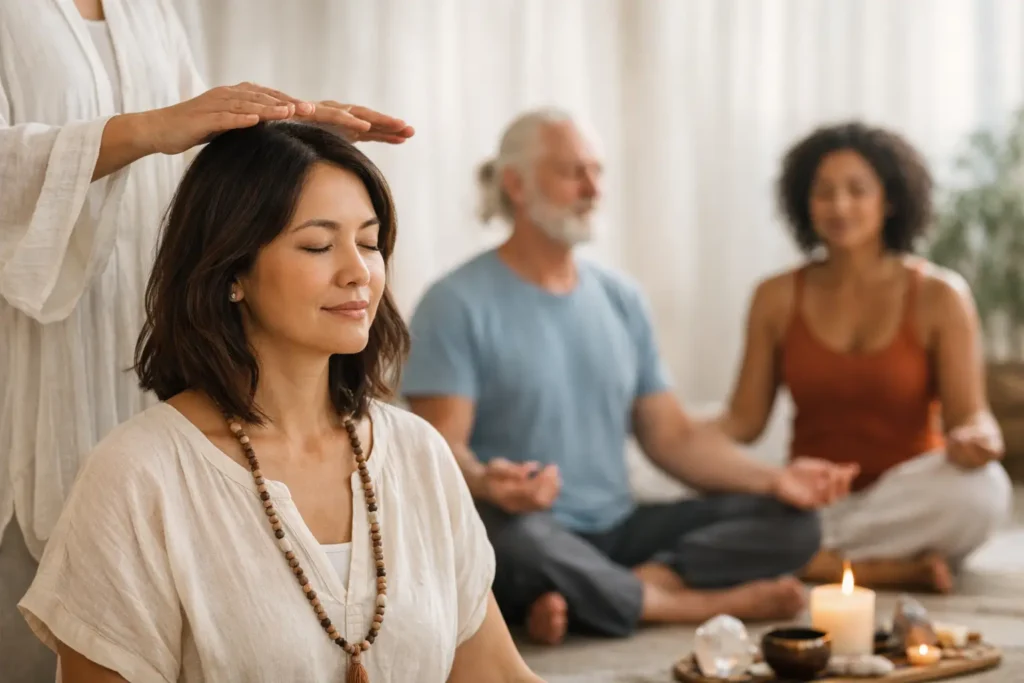
If you are new to energy healing, the unknown can feel like the biggest barrier. In most Reiki sessions, you remain fully clothed and lie on a treatment couch in a calm, quiet room. The practitioner may begin by explaining the process and asking how you have been feeling physically, emotionally, or mentally.
They then place their hands in a series of positions around the head, shoulders, torso, arms, legs, and feet, or work just above the body. Pressure is not used. The treatment is designed to be non-invasive and deeply restful.
People respond in different ways. Some drift into a light sleep. Some feel emotional and unexpectedly tearful. Some notice nothing dramatic in the moment but feel clearer, lighter, or more balanced afterwards. A few people feel energised rather than sleepy. It depends on what your system needs, how stressed you have been, and how open or tired you feel on the day.
This is one reason Reiki can be so appealing to people living with busy minds and full schedules. You do not have to perform, explain everything, or push through discomfort. You simply allow yourself to receive.
The benefits of Reiki spiritual healing
People often come to Reiki because something feels out of sync. They may be carrying the effects of burnout, grief, anxiety, poor sleep, emotional overload, or chronic tension. Reiki is not a cure-all, but it can be a meaningful part of a wider wellbeing plan.
One of the most widely reported benefits is deep relaxation. When the body moves out of a heightened stress response, it can become easier to breathe deeply, rest properly, and think more clearly. That shift alone can feel powerful for someone who has been operating in survival mode for weeks or months.
Reiki may also support emotional balance. Some clients find that it helps them process feelings they have been holding onto, while others simply notice more space around their thoughts. Life may not change overnight, but they feel more centred within it.
There can be physical benefits too, particularly when tension and stress are playing a part in how the body feels. Reiki is often chosen alongside other complementary treatments because it supports the whole person rather than one isolated symptom. In a holistic setting, that can be especially valuable.
The spiritual side of Reiki is often harder to define, yet deeply important. For some, healing is not only about reducing stress. It is also about feeling connected again – to self, to purpose, to stillness, to a sense of trust in life. Reiki can offer a gentle doorway into that experience.
Is Reiki spiritual healing religious?
This is a common and understandable question. Reiki is spiritual in the sense that it works with energy and often invites a deeper sense of connection, but it is not tied to one religion. You do not need to follow a particular faith, and you do not need to be especially spiritual, to receive a treatment.
Many people appreciate Reiki simply as a calming, restorative therapy. Others value it because it aligns with their personal spiritual practice. The beauty of Reiki is that it can meet you where you are. It is not there to impose beliefs. It is there to support balance.
If you are cautious about spiritual language, it helps to know that a reputable practitioner should explain Reiki clearly and respectfully. You should feel safe, informed, and comfortable throughout your session.
What Reiki can and cannot do
A balanced view matters. Reiki can be profoundly supportive, but it is not a replacement for medical care, mental health treatment, or professional diagnosis. If you are living with significant physical or psychological symptoms, Reiki is best approached as a complementary therapy rather than a standalone answer.
That said, complementary does not mean insignificant. Many people find that Reiki helps them cope better with stress, sleep more deeply, feel emotionally steadier, and reconnect with themselves in a way that supports their wider healing journey.
It is also worth knowing that Reiki is not always dramatic. Some sessions feel powerful and emotional. Others feel subtle. A quiet session is not a failed session. Often, the body responds gently, and the effect becomes clearer over the next day or two.
Who is Reiki most helpful for?
Reiki can be especially beneficial for people who feel mentally overloaded, emotionally stretched, or physically depleted. Working professionals under constant pressure, parents carrying invisible mental load, and anyone moving through grief, change, or exhaustion often find Reiki deeply nourishing.
It can also suit people who do not want a highly clinical environment. If you are looking for a therapy that feels calm, compassionate, and whole-person focused, Reiki may feel like a natural fit.
For those already on a personal growth path, Reiki can become more than an occasional treatment. Some people choose regular sessions as part of their self-care routine. Others feel inspired to study it themselves, whether for personal development or as the first step towards practitioner training.
In an established wellness centre such as Birmingham Holistic, Reiki often sits beautifully alongside massage, meditation, reflexology, and emotional wellbeing support because each approach speaks to a different part of the healing process.
How to know if Reiki is right for you
The best sign is often simple. You feel drawn to it. Not because you expect magic, but because something in you wants rest, balance, and a different kind of support.
If you are curious, begin with an open but grounded mindset. You do not need to arrive with firm beliefs or perfect understanding. You only need to choose a qualified practitioner, ask any questions you may have, and give yourself permission to experience the session without judgement.
Sometimes the value of Reiki lies in the treatment itself. Sometimes it lies in the pause it creates – a rare moment to stop bracing, stop managing, and listen to what your body and spirit have been trying to tell you.
Healing does not always begin with something dramatic. Sometimes it begins in a quiet room, with a sense of safety, and the feeling that you can finally exhale.